
Applications
• Water Treatment Technologies
- Photoelectrocatalytic
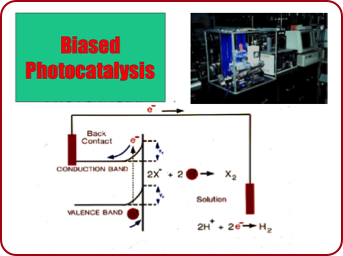
In electrocatalysis, the electron is removed to a counter electrode by applying a potential from a potentiostat. This has several advantages in the treatment of both inorganic and organic contaminants in the water phase. Firstly, the potential can be controlled and therefore, tailored for given oxidation/reduction of target compounds. Secondly, since the electron and hole are separated, recombination is prevented and efficiencies increased. We are using this process for both the oxidation of organics such as dye compounds but as well for the reduction of inorganic species such as chrome (VI). We are also using this process in the case of ammonium removal in aquariums and this process is being licensed by AquaMost for this application.