

Synthesis of Materials
• Sol preparation
Our colloids are fabricated though the hydrolysis and condensation of inorganic salts or metal alkoxides. We never work with or produce powders! Many of the precursor chemicals can be purchased in bulk quantity as large as 50 gallon drums or even tank cars. Particles are typically favored due to the fact that by controlling particle size and particle packing we produce well-tailored pore structures. By adjusting reaction conditions one can produce inorganic polymeric materials. Variables used to control these systems include: pH; concentration of metal salt or alkoxide; water to alkoxide molar ratios; ionic strength, and temperature. Primary particle size is less than 8 nm and often less than 5 nm. Our smallest particles are 1.5 nm in diameter. Due to the fact that these particles are extremely small, two phenomena can be anticipated: most of the molecules composing the particle are on the surface of the particle yielding high surface free energies and little bulk activity; and secondly, these particles display quantum confinement effects since the distance separating the hole and the electron in irradiated systems is larger than the size of our particles. We make a range of particles including: MgO, Al₂O₃, MnO₂, Fe₂O₃, ZrO₂, NiO, and SiO₂. We also produce mixed metal oxides such as Al₂O₃ – SiO₂ and ZrO₂ – TiO₂. Tri-component systems are also possible. In addition, we can dope these materials with noble metals such as Pt, Pd, and Rh in a highly controlled fashion making them useful as catalytic materials. Many of these suspensions are stabile for years. In the end, we are the “Ben and Jerry” of sols.
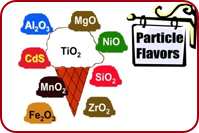

"Ben and Jerry" of sols
"lab fancy dress code"