
Applications
• Energy Storage Devices
- Ultracapacitors
Ultracapacitors fall between batteries and traditional electrolytic capacitors in their ability to store energy and deliver power.
The first successful ultracapacitors were based on electrochemical storage in the double layer near a high surface are material such as carbon aerogels. Since capacitance scales directly with surfaces area and inversely with distance, ions absorbed in the electrostatic double layers of these aerogels are only angstroms away from the surface producing a capacitance values orders of magnitude higher than traditional electrolytic capacitors. These capacitors are called double layer ultracapacitors.
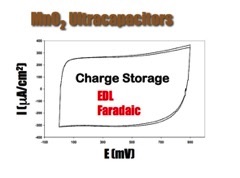
Somewhat later in time, newer pseudo capacitors utilizing materials such as RuO2, MnOx and NiOx were developed. These materials not only operate by means of double layer mechanisms but as well as through oxidation - reduction reactions. Our research group has worked with both MnOx and NiOx pseudo capacitors.
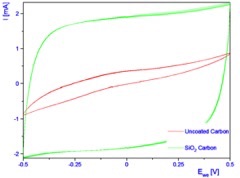
Lately, we have been using porous nanoparticulate sand -SiO2-, supported on inexpensive porous conducting carbon to store energy. We call these ¨Porous Oxide Electrolyte Membrane¨ (POEM) ultracapacitors. The bottom figure to the left shows the effect of adding a thin-film (membrane) of SiO2 materials on the carbon supports. One can notice the clear increase in capacitance related to our coatings. These technologies have been licensed by SolRayo and are currently being improved for a variety of applications.